

Table of Contents
Quick Cost Summary for 2026
Pool maintenance costs in 2026 vary significantly based on whether you manage maintenance yourself or hire professionals. Here's what you can expect to budget annually when accounting for chemicals, electricity, equipment care, and seasonal variations.
$80–$150
Self-managed maintenance
$150–$300
Professional service
$1,500–$3,600
Full-year budget range
$500–$1,000/yr
Replacement fund
Pro Tip: These figures are 2026 US national averages for in-ground residential pools (15,000–20,000 gallons). Costs vary by region, pool size, climate, and equipment age.
Monthly Cost Breakdown by Category
Understanding where your money goes each month helps you identify savings opportunities. This table breaks down typical expenses for DIY and professional pool maintenance across all major categories.
| Expense Category | DIY Cost | Pro Cost | Notes |
|---|---|---|---|
| Chemicals | $30–$50 | Included | Highest variable cost |
| Electricity (pump) | $30–$100 | $30–$100 | Homeowner pays regardless |
| Water (evaporation) | $10–$25 | $10–$25 | Homeowner pays regardless |
| Cleaning supplies | $5–$15 | $5–$15 | Replacement items |
| Testing | $5–$10 | $5–$10 | DIY: minimal |
| Service visits | $0 | $150–$300 | 1 visit weekly (standard) |
| MONTHLY TOTAL | $80–$150 | $200–$450 |
Note: Professional service fees ($150–$300/mo) cover weekly visits, chemical testing, and chemical dosing. Electricity, water, and equipment costs are always paid by the homeowner regardless of service type.
Chemical Costs Deep Dive
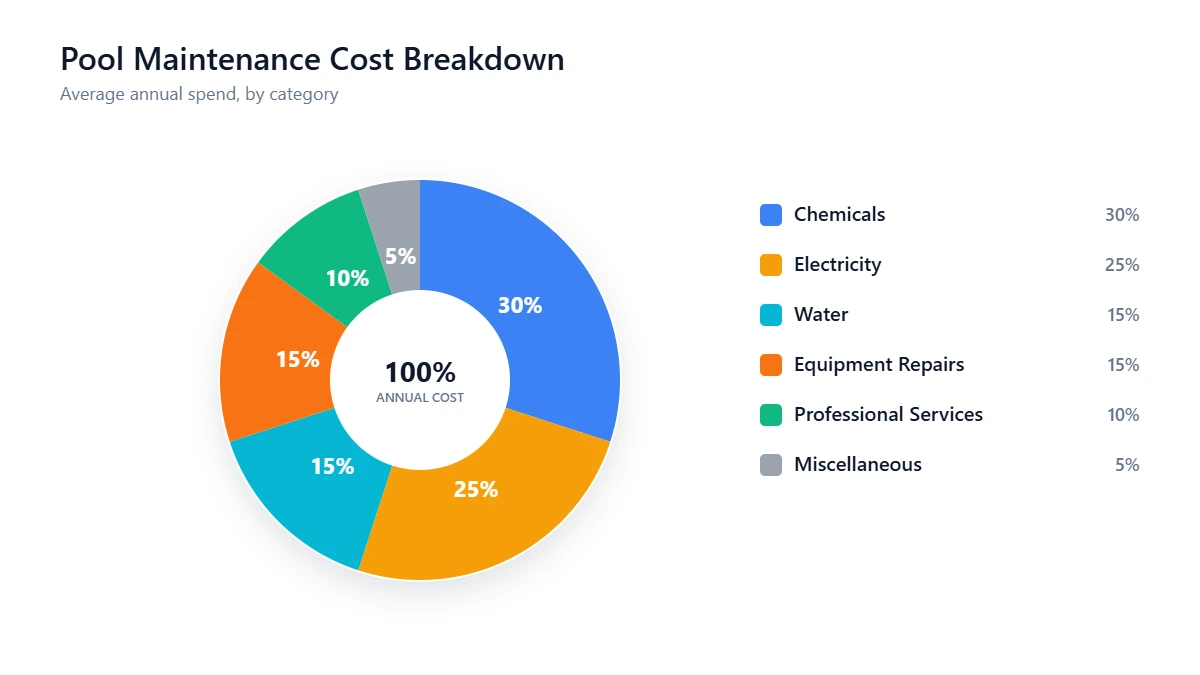
Chemicals represent the single largest variable cost in DIY pool maintenance. Different chemical types have vastly different price points, with costs influenced by pool size, season, and water conditions. Understanding the role of each chemical and its cost will help you budget more effectively.
Chlorine is your primary defense against algae and bacteria. Most pool owners use either liquid chlorine for its economy or tablets for convenience. Liquid chlorine (sodium hypochlorite) typically costs $30–$50 per month for a standard 20,000-gallon pool, making it the most economical choice. Chlorine tablets offer ease of use but run $40–$70 per month due to the convenience premium. Use our dosage calculator to determine exact chemical quantities needed. For serious savings, many professionals recommend buying liquid chlorine in bulk—a 55-gallon drum costs $120–$150 and lasts 2–3 months, bringing your effective monthly cost down to $40–$50.
pH adjustment is essential but often overlooked in cost calculations. Muriatic acid (hydrochloric acid) is the standard choice, costing only $8–$12 monthly but requiring 2–5 jugs per month depending on your water source and climate. If your water naturally trends alkaline or you're in a region with hard water, you might lean toward the higher end of that range. Learn proper pool water testing techniques—knowing exactly how much acid you need prevents both wasteful overdosing and incomplete correction.
CYA (cyanuric acid) is a stabilizer that protects chlorine from UV degradation. Unlike chemicals you add monthly, you typically add CYA once per season or do occasional top-ups, costing just $15–$20 annually. This minimal cost masks its importance—proper CYA levels (30–50 ppm) can cut your chlorine consumption significantly by letting the stabilized chlorine work more efficiently.
Algaecide serves as supplemental insurance, especially valuable in warm climates or during algae-prone seasons. Monthly algaecide costs $10–$15, primarily used during summer months when algae risk peaks. While not always necessary if chlorine is maintained at proper levels, many pool owners find it worthwhile insurance, particularly in areas with consistent heat that accelerates algae growth.
Shock treatment (granular calcium hypochlorite or trichlor) represents your emergency responder for algae blooms or high-demand periods. Shock treatments as needed during summer (typically 2–4 times per month after heavy use, rainstorms, or when chloramines exceed 0.5 ppm) add $15–$30 monthly to your chemical budget. This cost scales with pool size and usage patterns—a heavily used pool with frequent parties will need more frequent shocks than a residential pool used primarily by the family.
Smart Chemical Buying: Purchasing liquid chlorine in 55-gallon drums saves 20–30% compared to smaller containers, though requires storage space. Buy at the start of summer when prices are typically lower, and consider joining a pool owner's co-op if available in your area for bulk discounts.
Electricity: The Hidden Expense
The pool pump is often the single largest monthly cost for pool owners, yet many focus exclusively on chemicals. Understanding your pump type and runtime patterns is critical because electricity costs compound throughout the year and often represent 40–50% of total DIY maintenance costs.
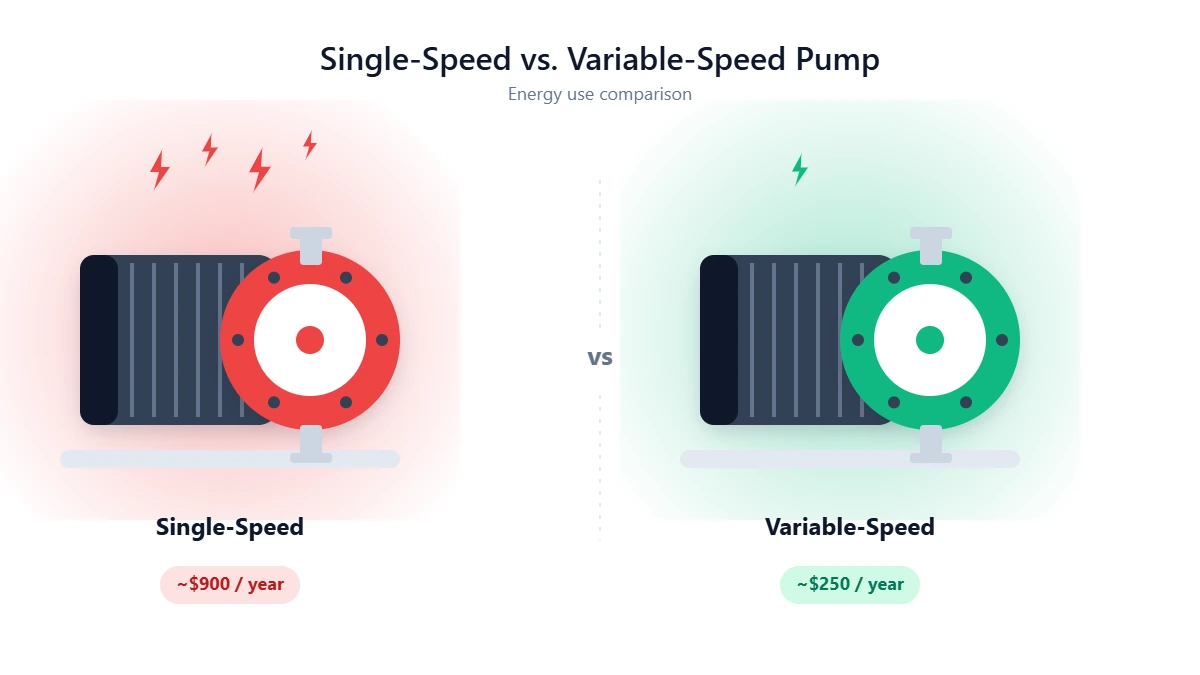
Pump Type Comparison: Annual Electricity Cost
Single-Speed Pump
Annual Cost
$600–$1,200
Monthly Average
$50–$100
How it works: Runs at full power continuously. Inefficient.
Variable-Speed Pump
Annual Cost
$400–$700
Monthly Average
$33–$58
How it works: Adjusts speed based on demand. 50–70% energy savings.
A variable-speed pump (VSP) represents one of the best investments for long-term cost reduction. While the initial upgrade costs $800–$1,000 installed, the annual savings of $200–$500 create a payback period of just 2–3 years. Use our VSP savings calculator to see your exact potential savings. Over a 10-year period, you'll save $2,000–$5,000 compared to sticking with your original single-speed pump.
Beyond pump selection, runtime management offers additional savings. Running your pump during off-peak hours (typically 9 PM to 6 AM) can save $50–$100 monthly depending on your local utility's time-of-use rates. Many pools don't need 24-hour circulation—a well-maintained pool with a clean filter and proper chemistry often thrives with 12–14 hours of daily circulation during the swimming season. Clean filters also matter: a clogged filter forces the pump to work harder, increasing electricity consumption. Regular filter cleaning (when pressure rises 8 psi above baseline) maintains efficiency and extends equipment life. If you're having equipment issues, check our equipment troubleshooter to diagnose problems before they become costly.
ROI: Variable-Speed Pump
Upgrade cost: $800–$1,000 (installed)
Annual savings: $200–$500
Payback period: 2–3 years
10-year savings: $2,000–$5,000
For personalized electricity savings estimates based on your specific pool size and local utility rates, use our VSP calculator. This tool factors in your exact energy consumption and pricing to show realistic savings projections.
DIY vs. Professional Pool Service
The biggest pool cost decision comes down to one question: maintain it yourself or hire a service? The answer isn't universal—it depends on your available time, comfort with chemistry, and preference for convenience over savings.
| Factor | DIY | Professional |
|---|---|---|
| Monthly Cost | $80–$150 | $150–$300+ |
| Time Commitment | 2–4 hours/week | 0 (hands-off) |
| Learning Curve | 1–2 weeks | None |
| Water Quality | Good if consistent | Professional-grade |
| Problem Detection | You spot issues | Early detection |
Choose DIY If You:
- Want to save $60–$150/month
- Have 2–4 hours weekly
- Own a small–medium pool
- Enjoy hands-on projects
- Have stable water conditions
Choose Professional If You:
- Value convenience over savings
- Have unpredictable conditions
- Own a large or salt-water pool
- Work long hours or travel
- Have aging equipment
Find a Local Pool Professional
Looking for reliable pool service in your area? Compare vetted professionals.
Browse Local ProsSeasonal Cost Calendar
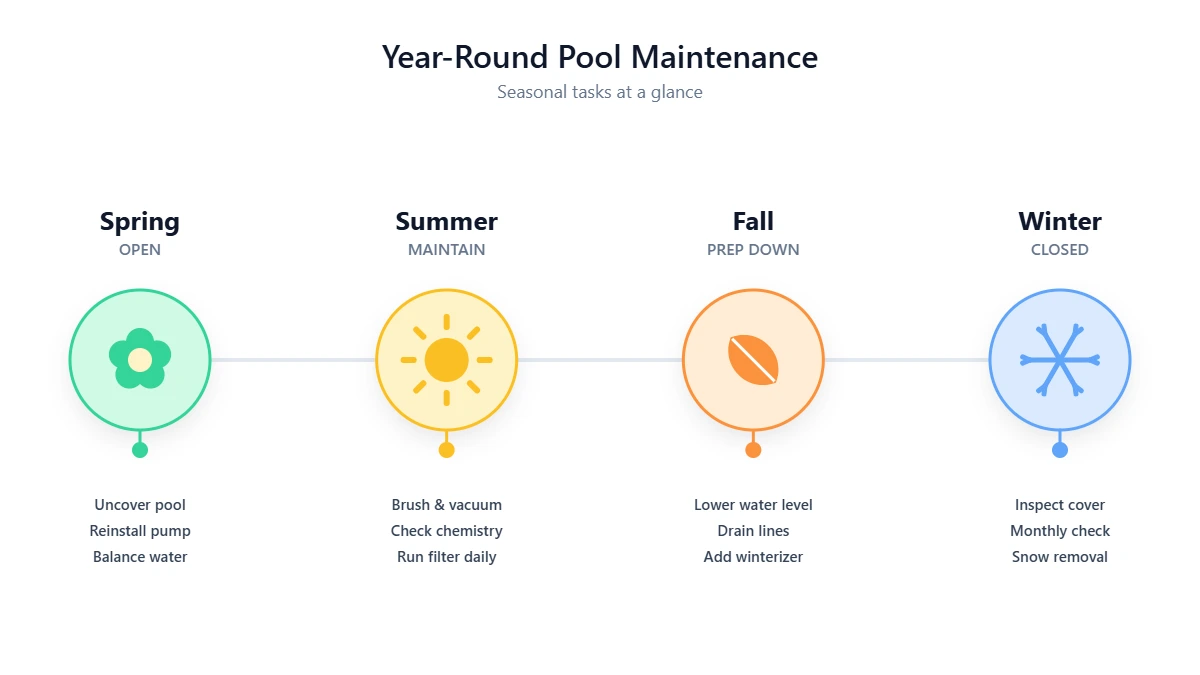
Pool costs fluctuate dramatically throughout the year. Spring brings opening preparations and equipment restarts, summer demands maximum chemical usage and electricity for circulation, fall requires closing procedures, and winter involves minimal care for closed pools. Planning around these seasonal variations helps you budget more accurately and avoid unexpected expenses.
Spring
$200–$400
Opening & startup
Summer
$150–$250/mo
Peak usage season
Fall
$200–$400
Closing & prep
Winter
$20–$50/mo
Minimal maintenance
Annual Budget Summary
Spring
$200–$400
Summer (4 mo)
$600–$1,000
Fall
$200–$400
Winter (4 mo)
$80–$200
DIY Total: $1,080–$2,000
Add equipment reserve: $500–$1,000/year
Realistic Total: $1,500–$3,000/year
Equipment Replacement Costs & Planning
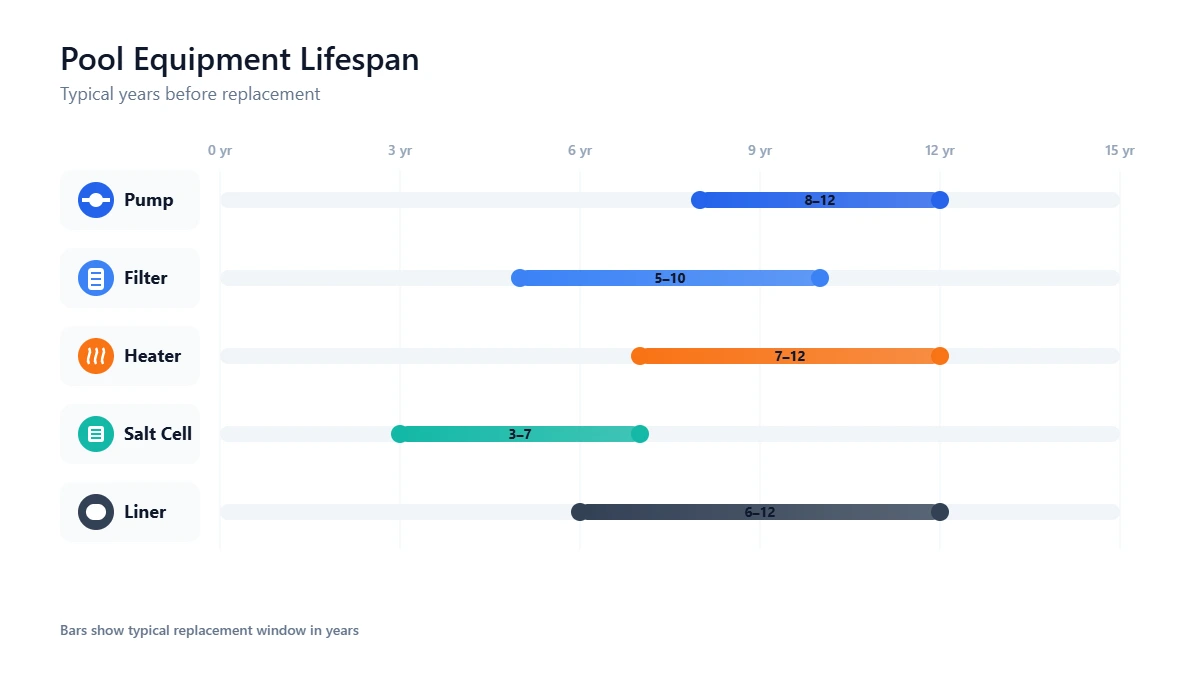
Equipment replacement is the one area most pool owners underbudget or ignore until failure forces emergency replacement at inflated prices. Major pool components have predictable lifespans—a pump typically lasts 8–12 years, filters 5–10 years, and heaters 8–12 years. Planning ahead by setting aside an equipment fund prevents financial surprises and allows you to upgrade strategically rather than reactively.
| Equipment | Lifespan | Replacement Cost | Notes |
|---|---|---|---|
| Pump (Single-Speed) | 8–12 yrs | $400–$1,500 | Most common |
| Pump (Variable-Speed) | 8–12 yrs | $1,200–$2,500 | Saves electricity |
| Filter (Sand) | 5–10 yrs | $200–$600 | Media $40–$80 |
| Filter (Cartridge) | 5–10 yrs | $300–$800 | Cartridges $30–$60 |
| Heater (Gas) | 8–12 yrs | $1,500–$3,000 | Install +$200–$500 |
| Salt Cell | 3–7 yrs | $300–$900 | Frequent replacement |
| Pool Liner | 7–12 yrs | $3,000–$5,000 | Vinyl pools only |
| Pool Cover | 5–10 yrs | $50–$500 | Tarp vs automatic |
The foundation of smart equipment planning is setting aside $500–$1,000 annually in an equipment replacement fund. This seemingly large amount averages to just $40–$80 monthly and ensures you're never caught off-guard by sudden failures. When your pump reaches 8 years old, begin evaluating replacement rather than waiting for catastrophic failure. Similarly, watch filter pressure gauges—when pressure rises 8+ psi above the baseline clean reading, it's time to clean or replace media.
Strategic upgrades amplify your savings. When replacing a pump, choosing a variable-speed model costs about $200–$400 more initially but saves $600–$960 annually in electricity. Over the 8–12 year pump lifespan, this upgrade essentially pays for itself while improving efficiency and environmental footprint.
One-Time and Occasional Costs
Beyond routine maintenance, pool ownership includes periodic expenses that can catch owners off guard. Planning for these prevents budget shock.
| Item | Typical Cost | Frequency |
|---|---|---|
| Pool Opening (DIY) | $75–$200 | Annual (spring) |
| Pool Opening (Pro) | $150–$400 | Annual (spring) |
| Pool Closing (DIY) | $100–$250 | Annual (fall) |
| Pool Closing (Pro) | $150–$400 | Annual (fall) |
| Acid Wash / Drain & Clean | $500–$1,000 | Every 3–5 years |
| Tile Line Cleaning | $200–$600 | Every 2–3 years |
| Leak Detection | $150–$400 | As needed |
| Leak Repair | $300–$3,000+ | As needed |
| Resurfacing (Plaster) | $4,000–$15,000 | Every 10–15 years |
| Liner Replacement | $3,000–$5,000 | Every 7–12 years |
The biggest occasional expense is resurfacing (plaster/pebble pools) or liner replacement (vinyl pools). Budget $300-$500 per year into a reserve fund so these major expenses do not come as a shock. If you suspect a leak, use our leak vs evaporation calculator before paying for professional leak detection.
Cost-Cutting Tips That Actually Work
Most cost-cutting advice is generic. Here are strategies that deliver measurable savings based on real pool owner data.
1Switch to a variable-speed pump
This is the single highest-impact upgrade. Running a VSP at low speed (1,200 RPM) instead of a single-speed at 3,450 RPM cuts electricity costs by 60-80%. At $0.15/kWh, that is $600-$960 saved per year. The pump pays for itself in 2-3 years and lasts 8-12 years. Use our VSP savings calculator for your exact numbers.
2Use a solar cover
A solar blanket ($50-$150) reduces evaporation by 95%, cutting water and chemical costs. It also raises water temperature 5-10°F for free, reducing heater gas bills. The savings easily exceed $200-$400 per season in chemicals, water, and heating combined.
3Buy chemicals in bulk during off-season
Chlorine prices spike 20-40% in May-June. Buy your season supply in March-April. Liquid chlorine has a short shelf life (6-8 weeks), but granular shock, CYA, and other dry chemicals store well for 1-2 years in a cool, dry place. Big-box stores often have better prices than pool specialty stores.
4Maintain consistent chemistry
Reactive pool care (fixing problems after they develop) costs 3-5x more than proactive maintenance. An algae bloom costs $50-$150 in shock and algaecide to fix. Testing twice a week and making small adjustments costs $5-$10 in chemicals per month. Consistent testing with a quality kit is the single best money-saving habit. See our testing guide.
5Do your own opening and closing
Professional opening and closing costs $300-$800 per year. Following our opening guide and closing guide, you can do both for $150-$350 in materials. That is $150-$450 saved every year.
Salt Water Pool Costs
Salt water pools have different cost structures than traditional chlorine pools. The upfront investment is higher, but ongoing costs are typically 30-50% lower.
Traditional Chlorine Pool
Salt Water Pool
Salt water pools break even on cost after 3-5 years. The real advantage is convenience: no buying, storing, or handling chlorine. The tradeoff is more vigilant pH management (salt cells push pH up constantly) and the recurring cell replacement cost. For a deep dive, see our complete salt water pool care guide and use the salt system health dashboard in our salt water care guide to monitor your system.
Frequently Asked Questions
How much does a pool cost per month?
Is pool maintenance cheaper if I do it myself?
What is the most expensive part of owning a pool?
How can I reduce my pool electricity bill?
Should I budget for a pool reserve fund?
Want a Custom Cost Estimate?
Get an Accurate Quote from a Local Pool Pro.
Every pool is different. A local professional can assess your specific setup — equipment age, pool size, water source — and give you a realistic annual maintenance budget with no surprises.
Related: How to Test Pool Water · Salt Water Pool Care Guide