
Table of Contents
How to Take a Water Sample
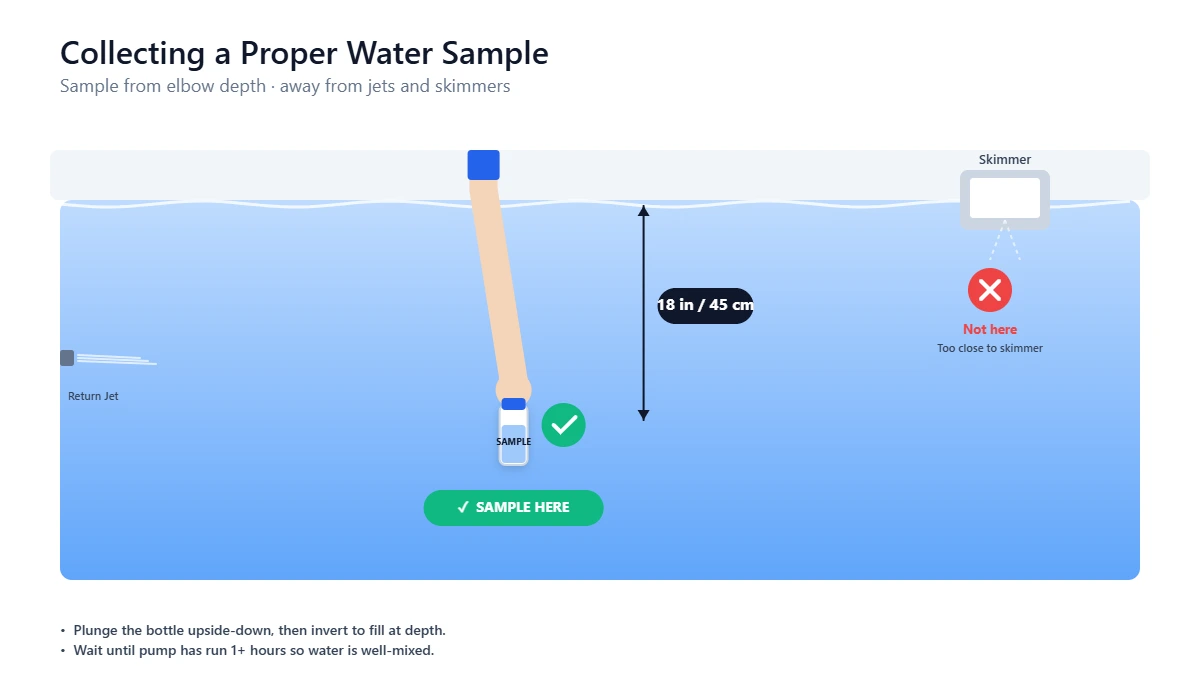
The accuracy of your test results depends 100% on the quality of your water sample. A contaminated sample will give you false readings that send you down the wrong path. Here is how to collect a proper sample every single time.
Avoid Return Jets
Never sample near return jets or skimmer baskets. These areas have fresh chemicals and do not represent the bulk pool water. Sample from the deep end, away from equipment returns.
Go Elbow Deep
Submerge your arm up to the elbow when filling your sample vial. Surface water is warmer and less representative. You want water from the deepest, coldest part of the pool.
Flip and Fill
Flip your sample vial upside down, submerge it, then flip it right-side up underwater. This purges air pockets and ensures you are testing pure pool water, not mixed air.
Test Strips vs. Liquid Drop Tests
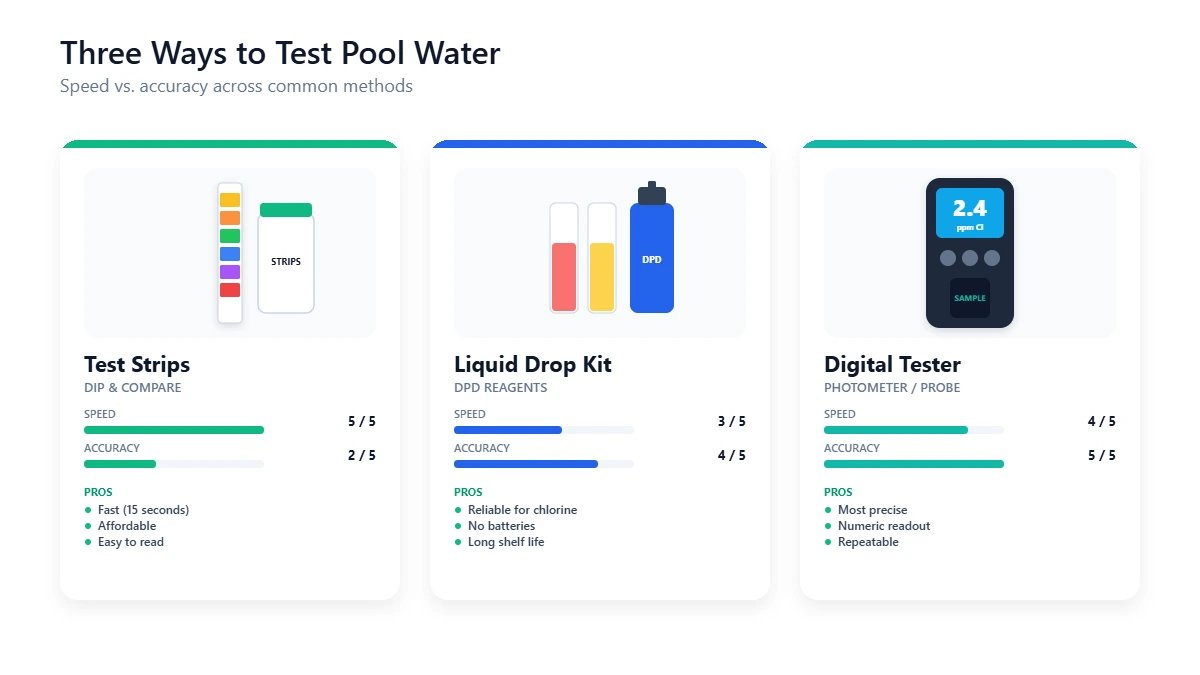
Not all testing methods are created equal. Here is a direct comparison of the two main approaches to pool water chemistry testing.
Test Strips
Strengths
- Fast results (30 seconds)
- Affordable ($15-30 per box)
- Easy to use, no mixing
- Good for routine monitoring
Flaws
- ±0.5 ppm accuracy (margin of error)
- No CYA test (critical gap)
- Color blindness not friendly
- High chlorine causes false pH
Liquid Drop Tests
Strengths
- ±0.2 ppm accuracy (professional grade)
- Includes CYA test (essential)
- Tests all 6 key parameters
- Hundreds of tests per kit
Flaws
- Takes 3-5 minutes per test
- Requires careful counting drops
- Reagents expire (shelf life)
- Higher upfront cost ($35-50)
The Smart Approach
Use test strips for frequent monitoring (daily, weekly) and a liquid drop kit every two weeks for critical measurements like CYA. This combination gives you speed and accuracy. Once you have your readings, use our Water Analyzer on our homepage for a plain-English diagnosis, or our dosage calculator to adjust chemicals precisely.
Video Masterclass: The Taylor K-2006 Walkthrough
Watch this step-by-step demonstration of how to use the industry-standard Taylor K-2006 liquid drop-test kit. Pay close attention to the counting technique and color matching.
Jump to Timestamp
Pool Chemistry Glossary
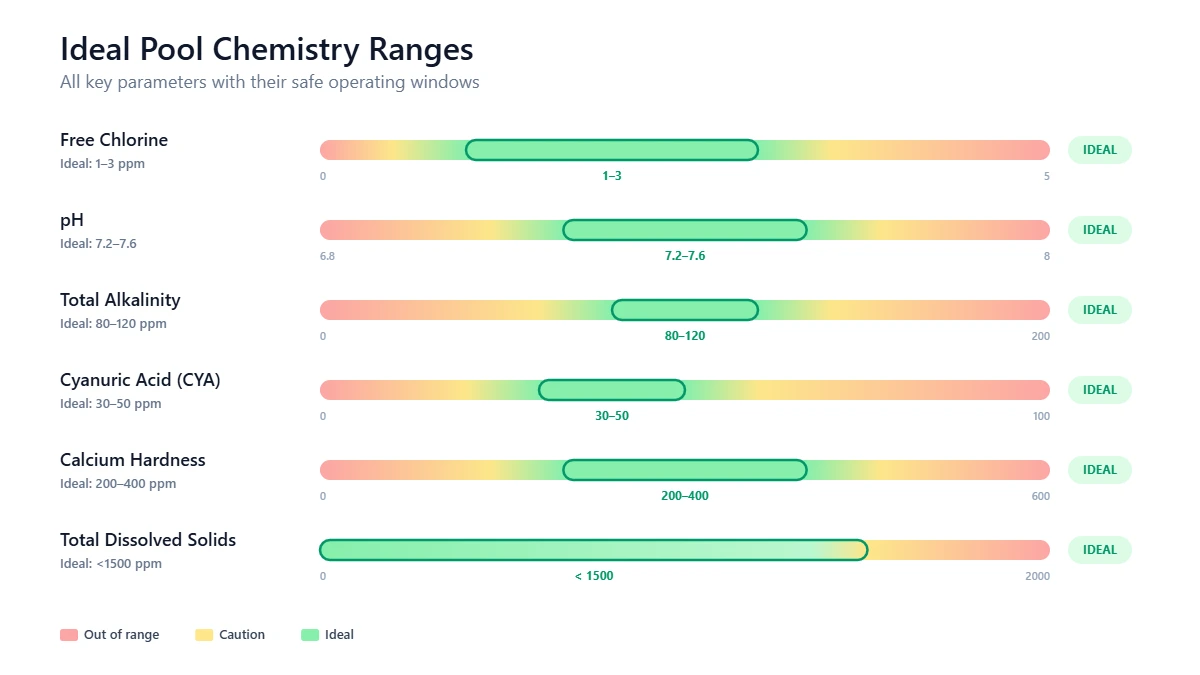
Master these six essential pool chemistry terms. Understanding what each chemical does is the foundation of good pool maintenance.
Free Chlorine
The active chlorine killing algae and bacteria right now.
Combined Chlorine
Spent chlorine that is no longer effective (bad stuff).
Potential Hydrogen
Measures how acidic or basic your water is (scale 0-14).
Total Alkalinity
The "shock absorber" that resists pH changes.
Cyanuric Acid
Protects chlorine from UV burn-off but can lock it up.
Calcium Hardness
Dissolved minerals that prevent scaling and etching.
Recommended Testing Schedule
The frequency of testing depends on your pool type and usage. Here is what the pros recommend.
High Traffic Pools
Public pools, daily swim team training, rental properties.
Test at consistent times. Log results to track trends.
Residential Pools
Regular family use, seasonal maintenance.
Sunday evening is ideal. Adjust based on weather.
Occasional Use
Secondary pools, spa-only setups.
Still test after shocking or chemical additions.
Always Test After
- Adding any chemicals (shock, stabilizer, alkalinity)
- Heavy rain or storms (water dilution)
- High bather load (pool party, crowded weekend)
- Extended absence (vacation shutdown)
CYA and Chlorine Target Engine
The amount of chlorine you need depends directly on your CYA level. Too much CYA "locks up" your chlorine, making it ineffective. Too little, and UV radiation destroys it. This is the sliding scale that most pool owners get wrong. If you have a salt water pool, CYA management is especially important — see our salt water pool care guide for specific targets. Understanding CYA is critical for preventing cloudy pool water issues.
The Rule: Your Free Chlorine (FC) should be 7.5% to 10% of your Cyanuric Acid (CYA) level. Use the calculator below to see your exact target. If chlorine gets too high, use our chlorine lock drain calculator.
Testing Interferences: When Your Results Lie
Pool water chemistry is not always straightforward. Several conditions can cause your test kit to give inaccurate readings, leading you to add chemicals you do not need or miss problems that exist.
High CYA Interference
CYA (cyanuric acid) above 80-100 ppm interferes with DPD chlorine test reagents, causing falsely high free chlorine readings. Your test might show 3 ppm FC when the actual effective chlorine is below 1 ppm. If CYA is high, use the FAS-DPD titration method (Taylor K-2006) instead of standard DPD drops or strips. Our water analyzer on our homepage accounts for the CYA-chlorine relationship.
Combined Chlorine Masking
Total chlorine test strips cannot distinguish between free chlorine (the sanitizer) and combined chlorine (used-up chloramines). You might see 3 ppm total chlorine and think you are safe, when actually 2.5 ppm is combined chlorine and only 0.5 ppm is active. Always test both free and total chlorine separately. Combined chlorine = Total - Free. If combined chlorine exceeds 0.5 ppm, breakpoint shock.
Expired Reagents
Liquid drop reagents lose accuracy after 12-18 months. Expired OTO (yellow chlorine test) and phenol red (pH test) reagents give unreliable readings. Replace your reagent kit annually at the start of each swim season. Store reagents in a cool, dark place. Never leave them in direct sunlight or a hot pool shed.
Test Strip Accuracy Limits
Test strips are convenient but inherently less accurate than liquid drop kits. Strips can be off by 0.2-0.4 pH units and 0.5-1.0 ppm chlorine. Humidity, age, and improper storage degrade strip accuracy further. Use strips for quick daily checks, but verify with a liquid drop kit at least once a week for critical decisions like shocking or acid dosing.
When to Test: Timing Matters
When you test is almost as important as how you test. Testing at the wrong time gives misleading results.
Optimal Testing Schedule
Pro Tip: Never test pool water within 24 hours of shocking. Shock creates extremely high chlorine levels that bleach test reagents and give inaccurate results for all parameters, not just chlorine.
Smart Water Monitors: Are They Worth It?
Smart pool monitors continuously measure water chemistry and send alerts to your phone. They range from $150 to $500+ and promise to replace manual testing. Here is an honest assessment.
Pros
Continuous monitoring catches chlorine drops before they become algae blooms. Some models test pH, ORP (oxidation-reduction potential), and temperature every hour.
Phone alerts mean you can respond quickly even when away from home. Helpful for vacation homes or rental properties.
Historical data and trends help you understand your pool's patterns and optimize chemical usage.
Cons
Most monitors measure ORP, not free chlorine directly. ORP is affected by pH, temperature, and CYA, making it a rough proxy at best. You still need manual testing.
Sensors require calibration every 1-2 months and replacement every 1-2 years ($50-$100 per sensor).
Cannot test alkalinity, calcium hardness, or CYA. You still need a manual test kit for these critical parameters.
Verdict: Smart monitors are a helpful supplement for pool owners who want early warnings, especially for vacation homes. But they do not replace a quality liquid drop test kit. Think of them as an alarm system, not a replacement for manual testing. If budget is a concern, invest in a Taylor K-2006 test kit ($70-$90) before spending $300+ on a smart monitor.
Numbers Not Adding Up?
A Pool Pro Can Test and Balance Your Water Fast.
If your test results look confusing or your water still isn't right after adjusting, a local professional can run a full analysis — including metals, TDS, and saturation index — and dial in your chemistry in one visit.
Related: Cloudy Pool Water Guide · Pool Algae Treatment