
Table of Contents
Algae is your pool's ancient enemy. It appears suddenly, spreads aggressively, and comes in multiple dangerous forms. But here is the good news: every type of algae has a specific treatment protocol that works if you follow it exactly.
The key is identifying which type you have before it takes over your entire pool. Some algae die in 24 hours with the right shock. Others require aggressive brushing, specialized algaecides, and even professional intervention.
Quick Visual Identification Guide
Know your enemy: Compare all four algae types side by side
Green Algae
Mustard Algae
Black Algae
Pink "Algae" (Bacteria)
How Algae Gets Into Your Pool
Algae spores are literally everywhere. They travel through the air, arrive on swimsuits, blow in with wind, and fall during rainfall. Your pool is under constant algae attack every single day. The only thing keeping them at bay is your Free Chlorine level.
The Bloom Trigger: Chlorine Drops Below Threshold
Here is the science: Algae spores are killed instantly when free chlorine is adequate. But if your chlorine level drops for any reason—perhaps from a heat wave, high bather load, or simply neglect—surviving spores begin exponential reproduction. A small green haze can become a complete swamp in just 24 to 48 hours.
Why Low Chlorine = Green Pool
- Heat accelerates algae growth: Warm water (80°F+) multiplies the reproduction rate.
- Sunlight burns off chlorine: UV radiation degrades free chlorine during the day.
- Organic matter consumes chlorine: Leaves, pollen, sweat, and sunscreen all demand chlorine.
- High CYA locks chlorine: Stabilizer reduces chlorine's killing power; you need more of it to stay protected.
- Poor circulation = dead zones: Algae thrives in stagnant water where the pump does not reach.
Bottom line: Algae is not a disease that strikes randomly. It is the direct result of inadequate free chlorine. Prevention means maintaining the right chlorine level year-round.
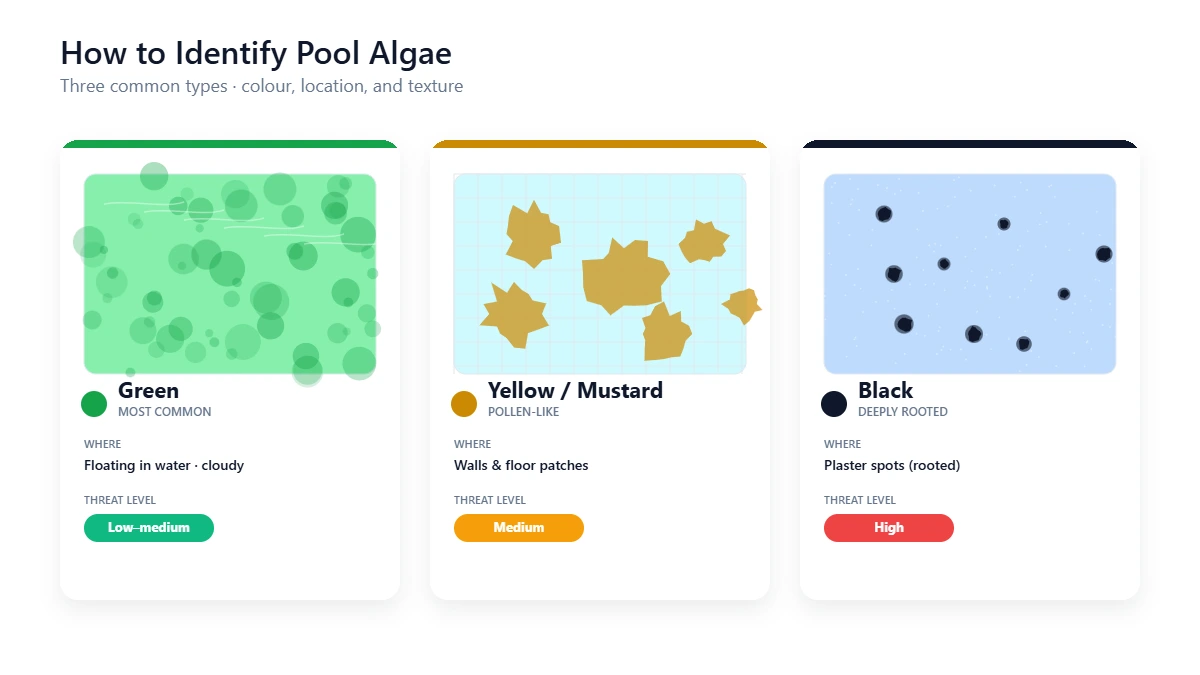
Green Algae: The Common Invader
Green algae is by far the most common type homeowners encounter. It is also the easiest to kill—if you do it right.
Why Green Algae Blooms
Green algae thrives on photosynthesis (it needs sunlight) and nitrogen (found in organic matter like leaves and sunscreen). When your chlorine drops below the minimum for your CYA level, the spores germinate and spread exponentially, turning your crystal-clear pool into a murky green soup in less than 48 hours.
Severity Levels & Treatment Approach
Light Green Haze (Barely Visible)
Chlorine dose: 1 to 2 ppm shock over target FC.
Timeline: Clear in 6-12 hours.
Action: One standard shock application, brush once, maintain pump 8+ hours daily.
Medium Green (Can See to 2-3 Feet)
Chlorine dose: 2 to 4 ppm shock over target FC (standard SLAM).
Timeline: Clear in 24-36 hours.
Action: Full SLAM method—brush twice daily, run pump 24/7, test every 4-6 hours, maintain target FC until water holds chlorine overnight.
Dark Green Swamp (Cannot See Bottom)
Chlorine dose: 4 to 6 ppm (or more) shock over target FC.
Timeline: Clear in 36-48 hours (possibly longer).
Action: Aggressive SLAM method with high shock, brush 3+ times daily, 24/7 pump operation, possibly add algaecide to speed kill, test every 2-3 hours to maintain FC target.
Stop Guessing on Shock Dosage
Enter your CYA level and pool volume to calculate exact chlorine dosage. Every ppm matters.
Use Shock CalculatorGreen Algae Treatment Protocol
For detailed step-by-step instructions on the professional SLAM method, see our how to shock a green pool guide. The short version:
- Test CYA first (use a Taylor K-2006 Test Kit, not strips).
- Lower pH to 7.2 with muriatic acid.
- Calculate shock target using SLAM formula based on your CYA level, then use our shock calculator.
- Add liquid chlorine after sunset to prevent UV burn-off.
- Run pump 24/7 and brush twice daily until water clears and holds chlorine overnight.
Yellow (Mustard) Algae: The Stubborn One
Yellow algae is chlorine-resistant. That means standard shock doses will not kill it. This is why it requires a completely different treatment protocol.
Why Yellow Algae is Different
Mustard algae has adapted to resist chlorine. It can survive in pools with moderate chlorine levels that would kill green algae. It also tends to cling stubbornly to shady areas—under the skimmer, around equipment, and in corners where sunlight does not reach.
The classic mistake: Homeowners throw in standard shock, see that the yellow does not disappear, and think their pool is broken. But the algae is simply more resilient.
The Triple Treatment Protocol
Step 1: Remove & Sanitize Everything
This is critical. Yellow algae clings to everything it touches. If you do not remove contaminated pool toys, floats, cleaning brushes, and equipment, the algae will re-infect the water within days.
- Remove all pool toys, floats, inflatables, and water toys.
- Remove all pool cleaning equipment (brushes, vacuums, nets).
- Remove ladder, steps, and any removable equipment.
- Sanitize everything: Soak in a 10:1 water-to-bleach solution for 2+ hours, then rinse thoroughly before returning to pool.
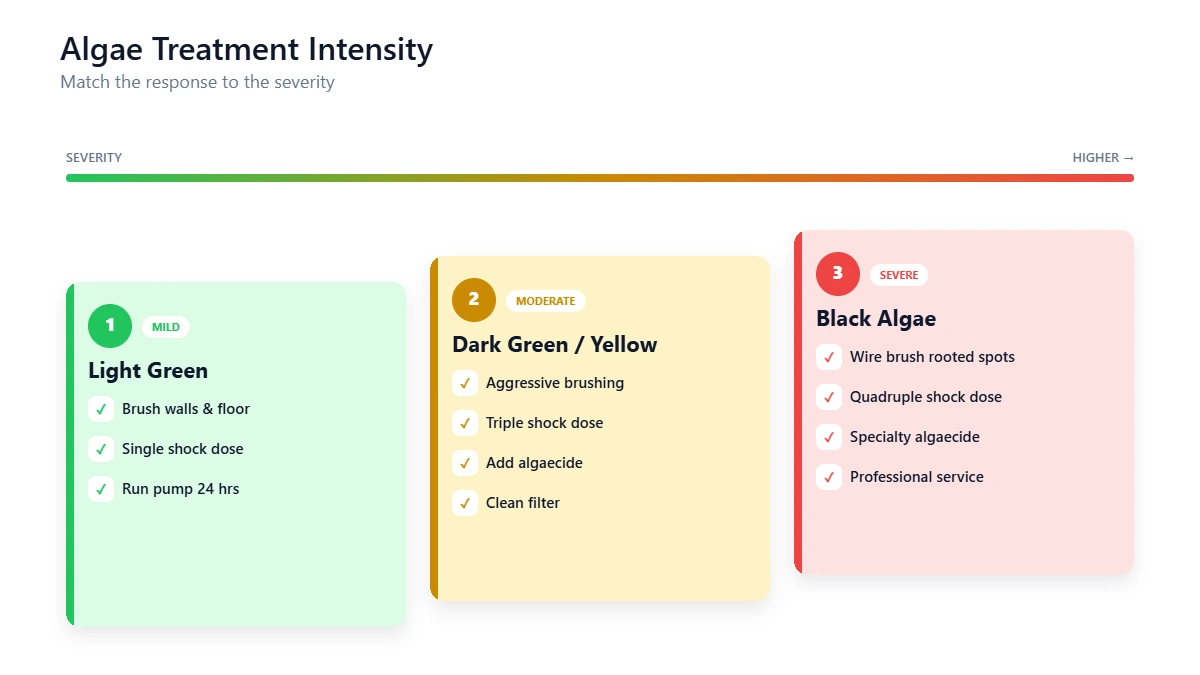
Step 2: Aggressive Brushing, Then Triple Shock
Brush the entire pool vigorously to break up the algae cell wall (it is tougher than green algae). Then apply 3x the standard shock dose.
- Brush walls, floor, steps, and equipment thoroughly.
- Lower pH to 7.0 with muriatic acid.
- Apply shock to your normal SLAM target based on your CYA level and maintain that level consistently for 5–7 days. The algaecide in Step 3 does the heavy lifting against chlorine-resistant algae — brute-force chlorine levels are unnecessary and can damage pool surfaces.
- Run pump 24/7 and brush twice daily for 5–7 days until all traces are gone.
Step 3: Add Algaecide (Copper-Based)
Algaecide 60 is a copper-based chemical that kills chlorine-resistant algae. Use ONLY after shocking, never before.
- Wait until free chlorine drops to 5-10 ppm (about 12-24 hours after shock).
- Add Algaecide 60 at the rate specified on the bottle (typically 1-2 quarts per 10,000 gallons).
- Maintain free chlorine at 10+ ppm for 5-7 days.
- Continue brushing twice daily for 5 days.
Warning: Sanitize First
Do not skip Step 1. Mustard algae will re-bloom within days if you re-introduce contaminated pool toys and equipment into the water. Take the time to properly sanitize everything.
Mustard Algae Cost Estimate
Use our dosage calculator and seasonal supplies checklist to plan your budget and stay ahead of algae blooms.
- Triple shock (Cal-Hypo Shock): $30-50
- Algaecide 60: $15-30
- Muriatic acid (for pH adjustment): $5-10
- Total: $50-90 per 20,000-gallon pool
Black Algae: The Deep-Rooted Menace
Black algae is the most dreaded type. It is not actually a single-celled organism like green or yellow algae—it is a multi-cellular, photosynthetic organism that grows roots deep into pool plaster and grout. This is why it is so hard to kill.
Why Black Algae is Difficult
- Protective outer layer: Black algae has a waxy, protective coating that makes it resistant to chemicals.
- Deep-rooted structure: The organism penetrates the plaster surface and can regrow from remaining root fragments if not completely eradicated.
- Non-free-floating: Unlike green algae, it does not cloud the water—so you notice it only after spots have already formed.
- Highly infectious: Even tiny spores on a cleaning brush or net can re-contaminate the entire pool.
The Aggressive Treatment Protocol
Step 1: Aggressive Brushing (Stainless Steel Only)
This is the most important step. You MUST physically remove the outer layer of algae and penetrate the roots. Use only a stainless steel pool brush—nylon brushes are too soft and will not break through the protective layer.
Vinyl & Fiberglass Pools
Stainless steel brushes are for plaster and concrete pools ONLY. Using a stainless steel brush on vinyl will shred the liner. On fiberglass, it will permanently scratch the gelcoat. If you have vinyl or fiberglass and suspect black algae, use a nylon brush and consult a pool professional — black algae is extremely rare in non-porous surfaces.
- Brush affected spots hard, multiple times daily for 3-5 days.
- Aim to scrape away the dark spots as much as possible.
- Do not be gentle—aggressive brushing is necessary.
- Sanitize the brush daily in bleach solution to prevent re-contamination.
Step 2: Apply Granular Trichlor Directly to Spots
While the spots are still wet from brushing, apply granular Trichlor (Sodium Trichloroisocyanurate) directly to the affected areas using a small scoop or mesh bag.
- Apply trichlor powder directly to wet black spots.
- Brush over the area gently to work the powder into the spot.
- Do this twice daily (morning and evening) for 5-7 days.
- Avoid getting undissolved trichlor powder into the main pool.
- Plaster pools only: Do not apply concentrated trichlor to vinyl liners or fiberglass — it will bleach and damage the surface.
Step 3: Shock to 30+ PPM
Black algae requires a higher free chlorine level than green algae. You must maintain 30+ ppm for several days (or even weeks).
- Calculate your normal SLAM target, then double it.
- Maintain 30+ ppm free chlorine for a minimum of 3-7 days.
- Run pump 24/7.
- Brush 3+ times daily for the first week.
- Test chlorine every 4-6 hours and re-dose as needed to maintain 30+ ppm.
When to Call a Professional
If after 2-4 weeks of aggressive treatment the black algae is still present, or if the spots are covering more than 30% of the pool surface, you likely need acid washing or even replastering. A professional pool company can perform acid washing, which chemically strips the pool surface and kills the algae roots permanently. Check our equipment troubleshooter if you suspect surface or structural damage.
Black algae cost estimate:
- DIY treatment (stainless brush, trichlor, high-dose shock): $60-120
- Professional acid washing: $800-$2,000+
Dealing With Black Algae?
Black algae requires aggressive treatment that can damage surfaces. A certified pool tech has the right tools and chemicals.
Pink "Algae" (Bacteria): The Hidden Threat
Pink algae is not actually algae—it is Methylobacterium, an airborne bacterium that is extremely common and often overlooked. It appears as a slimy pink or salmon film, usually found in hard-to-reach places like inside return lines, on ladder steps, in light corners, or under the pump.
Why Pink Bacteria is Deceptive
Most homeowners do not even realize they have pink bacteria because it does not typically affect the whole pool. It grows in specific areas with poor water circulation—inside pipes, corners, and equipment where chlorine does not easily reach. The fact that you do not see the whole pool turning pink makes people underestimate the problem.
Pink Bacteria Treatment
Use a high-quality test kit and proper testing technique to verify your chlorine levels throughout treatment. Also review our pool filter guide to ensure adequate circulation, and consider a robotic cleaner to improve overall pool circulation and reduce stagnant areas where bacteria hides.
Step 1: Shock the Pool to Normal Levels
Standard SLAM method — maintain your CYA-based SLAM target chlorine level for 2–3 days with 24/7 pump operation. Use our shock calculator to determine your exact target.
Step 2: Clean Pipes with Chlorine Tablets
Pink bacteria hides inside return lines and equipment. Shut off the pump and add chlorine tablets directly to the pump strainer basket or use a PVC pipe cleaner with chlorine. Let sit for 2-4 hours, then turn the pump back on to distribute.
Step 3: Brush and Clean Visible Areas
Remove the ladder, clean all surfaces where pink film was visible with a brush and chlorine solution. Sanitize any removable equipment.
Step 4: Improve Circulation
Pink bacteria thrives in stagnant areas. Make sure your pump runs long enough daily (minimum 8-12 hours) and your filter is clean. Consider increasing pump runtime to 12+ hours to improve circulation to all areas.
Pink bacteria cost estimate: $25-50 (standard chlorine shock + pipe cleaner)
Algae Treatment Comparison Table
Use this table as a quick reference to understand the differences between all four types.
| Type | Color | Location | Difficulty | Treatment | Time to Clear | Cost (20K gal) |
|---|---|---|---|---|---|---|
| Green | Green/murky | Free-floating, whole pool | Easy | SLAM method | 24-48 hrs | $15-40 |
| Mustard | Yellow/tan | Shady areas, walls, equipment | Hard | Triple shock + algaecide 60 | 3-7 days | $50-90 |
| Black | Dark/spots | Plaster, grout, deep-rooted | Extreme | Stainless brush + trichlor + 30+ ppm shock | 1-4 weeks | $60-120 (DIY) |
| Pink (Bacteria) | Pink/salmon | Inside pipes, corners, ladders | Moderate | SLAM + pipe cleaning | 2–3 days | $25–50 |
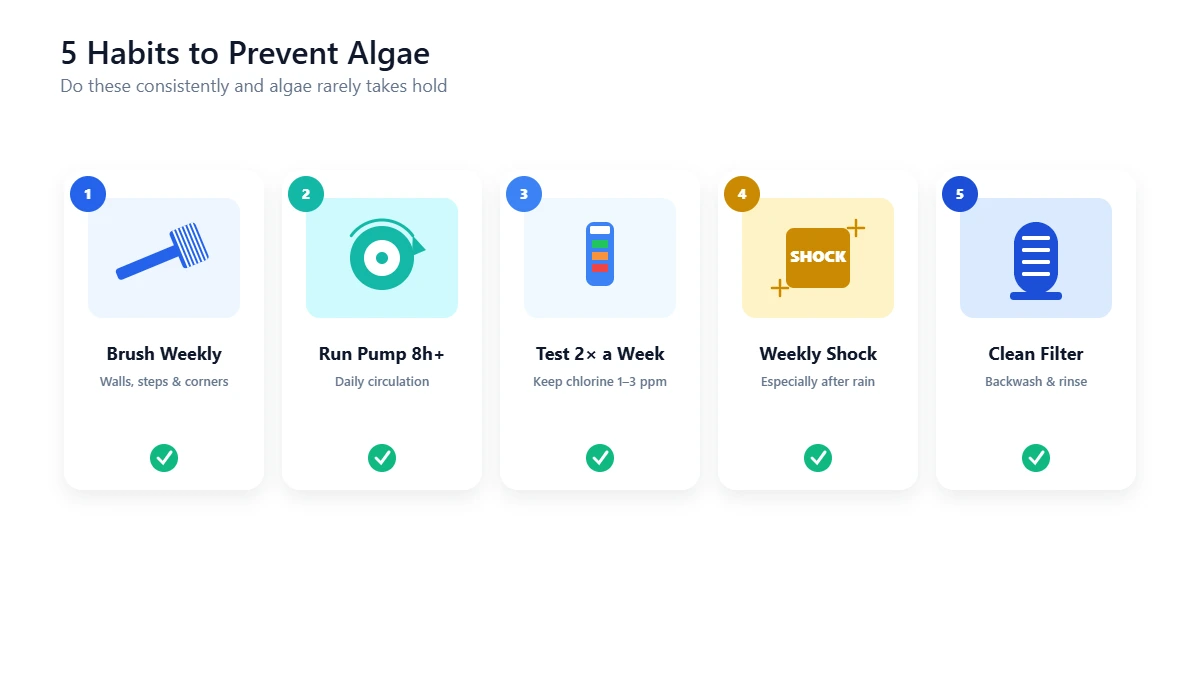
Prevention: The 5 Rules That Stop Algae
Preventing algae is vastly cheaper and easier than treating it. These five habits, practiced consistently, make algae blooms nearly impossible.
Circulation
Run your pump 8-12 hours daily. Algae thrives in stagnant water. Ensure all areas receive flow, especially dead spots behind ladders and in corners. Point return jets to create circular flow.
Filtration
Clean or backwash your filter regularly. A clogged filter cannot remove algae spores. Check filter pressure weekly. Clean when pressure rises 8-10 PSI above baseline. See our filter guide.
Sanitation
Maintain free chlorine at 2-4 ppm at all times. Never let it drop below 1 ppm. Chlorine is your primary algae killer. If you use CYA, maintain the proper FC/CYA ratio (7.5% of CYA level). Use our water analyzer on our homepage.
Testing
Test free chlorine and pH 2-3 times per week during swim season. Test alkalinity, CYA, and calcium hardness monthly. Catching a chlorine drop early prevents algae from establishing. See our testing guide.
Brushing
Brush walls, floor, steps, and corners 2-3 times per week. Brushing disrupts biofilm where algae anchors and exposes it to chlorine. Use a stainless steel brush for plaster, nylon for vinyl and fiberglass.
The 80/20 Rule: Consistent chlorine levels prevent 80% of algae problems. The other 20% is covered by proper circulation and regular brushing. If you only do one thing, keep your chlorine above 2 ppm at all times.
When to Call a Professional
Most algae problems can be handled DIY. But some situations warrant professional help to avoid wasting time and money.
Find a pool professional near you who can diagnose persistent algae issues.
Frequently Asked Questions
Can I swim in a pool with algae?
How long does it take to clear algae?
Why does my pool keep getting algae?
Does algaecide prevent algae?
What is the cheapest way to get rid of pool algae?
Algae Keeps Coming Back?
You Might Have a Hidden Circulation or Filtration Problem.
Recurring algae usually points to a dead spot in circulation, an undersized pump, or a filter that needs media replacement. A local pool professional can diagnose the root cause and stop the cycle for good.
Related: How to Shock a Green Pool · Cloudy Pool Water Guide