

Table of Contents
30-Second Cheat Sheet
Vitamin C Test lifts metal stains
Trichlor Test bleaches organic stains
Color Clue: Brown=Iron, Teal=Copper, Green=Organic
The 2 Golden Rules of Stain Diagnosis
Pool professionals don't guess what a stain is; they use chemical reactions to prove it. You can perform these exact same tests using items you likely already have in your house.
Test 1: The Vitamin C Test (For Metals)
Ascorbic acid (Vitamin C) is a powerful reducing agent that instantly lifts metal stains off pool plaster. Crush up a handful of cheap Vitamin C tablets, put them inside a thin white sock, and hold it directly against the pool stain for 30 seconds. If the stain vanishes or turns significantly lighter, it is a metal stain.
Test 2: The Trichlor Test (For Organics)
If the Vitamin C did nothing, the stain is likely organic. To prove it, take a standard 3-inch chlorine tablet (Trichlor) and hold it directly on the stain for exactly 30 seconds (do not leave it longer or it will etch your plaster). If the stain bleaches away and disappears, it is organic matter.
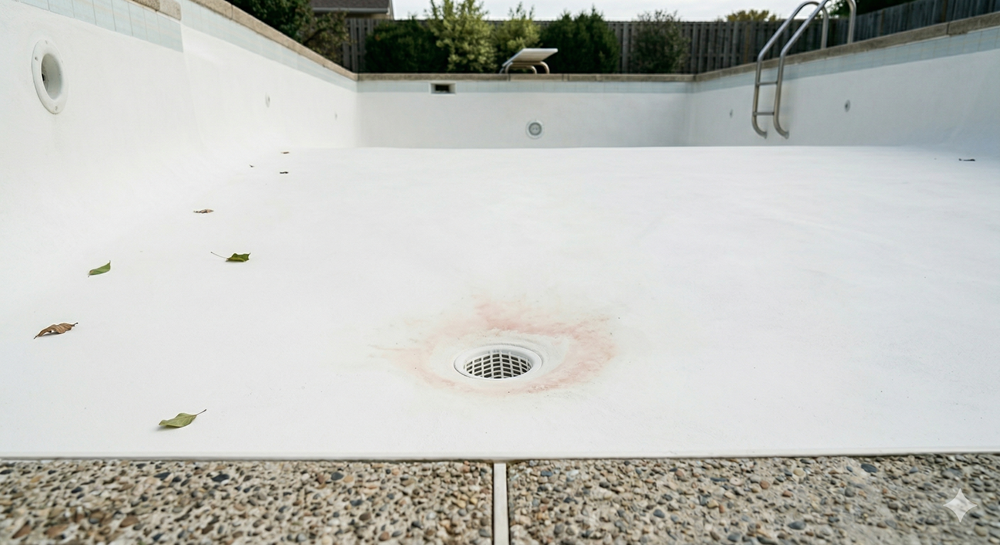
Stain Color Matrix
While the chemical tests above are the only way to be 100% certain, the color of your pool stain gives you a massive clue about the underlying cause.
Interactive Diagnostic Wizard
Perform the tests above, select your stain color, and let our engine generate your exact chemical treatment protocol.
Frequently Asked Questions
What is the Vitamin C test for pool stains?
The Vitamin C test is a diagnostic trick used to identify metal stains. Place a handful of crushed, cheap Vitamin C tablets (Ascorbic Acid) inside an old sock and rub it directly on the pool stain. If the stain vanishes or lightens instantly, it is a metal stain (usually iron). If nothing happens, it is likely an organic stain.
Why did my pool turn green when I shocked it?
If your pool water turns neon green, teal, or purple immediately after adding chlorine shock, you have high levels of dissolved copper in the water. The chlorine oxidized the copper, turning it into a visible suspension. You must use a metal sequestrant to bind the copper and filter it out.
How do you remove organic stains from a pool?
Organic stains (caused by leaves, acorns, or dead algae) are easily removed by elevating the Free Chlorine levels. You can test this by holding a standard 3-inch Trichlor tablet directly on the stain for 30 seconds. If it bleaches away, it is organic. To clear the whole pool, brush the surfaces and perform a SLAM (Shock Level and Maintain) treatment.
Need to Treat an Organic Stain?
If the Trichlor test proved your stain is organic, you need to elevate your chlorine levels to aggressively bleach the plaster clean. Use our calculators to find your exact shock dosage.
Related Reading: Why Is My Pool Cloudy? 3 Hidden Culprits